
‘CrewCare-HHS’ to deliver unobtrusive multimodal sensors and advanced analytics for real-time health and performance monitoring
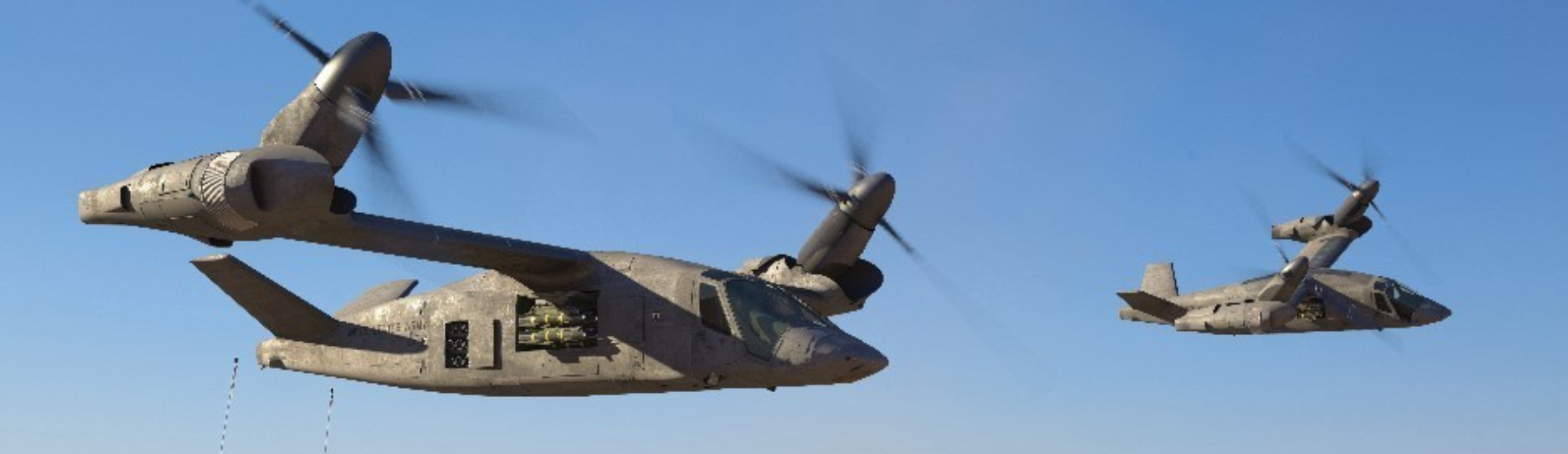
Woburn, MA – March 24, 2025 – The Army Futures Command (AFC) Future Vertical Lift (FVL) program is driving a transformative leap in military helicopter technology, introducing artificial intelligence (AI)-enabled systems and increased complexity.
This evolution underscores the critical role of the pilot, whose responsibilities are shifting in this new landscape. These new advances increase the need for real-time health and performance monitoring so that either pilot or aircraft can intervene when necessary.

Photo by Bell Helicopter courtesy of https://www.dvidshub.net/image/5216755/valor-action (public domain)
Aptima is developing the CrewCare-Helmet Health System (CrewCare-HHS) to address this need. CrewCare-HHS comprises unobtrusive multimodal forehead sensors, comprehensive data analytics, and user-facing insights and alerts about health and performance states. Sensors employ optical (photoplethysmography [PPG], pulse oximetry, near infrared spectroscopy sensing [NIRS]) and accelerometer technologies all within a compact, low-profile footprint, making it compatible with Army helicopter pilots’ current equipment and procedures. CrewCare-HHS’s modular analytic framework monitors vital signs and cognitive load and detects early indicators of physiological episodes such as hypoxia and hydrostatic shock.
CrewCare-HHS is part of Aptima’s Sensor-based Assessment Technologies (SAT) portfolio of solutions leveraging compact, unobtrusive sensors to collect and analyze data for real-time assessment of human performance and psychophysiological states. SAT utilizes a variety of sensors and techniques, including leveraging machine learning and advanced analytics processing of multimodal (physiological and neural) data, to provide detailed insights into an individual’s state and abilities. By integrating these technologies, Aptima can offer solutions that enable continuous physiological monitoring, performance assessment, cognitive state estimation, and behavioral activity prediction all with seamless integration with other systems. This advanced approach ensures Warfighters can maintain optimal performance and safety, even in the most demanding environments.
To learn more about how Aptima is applying precision performance monitoring for critical operations to enhance human performance and safety in mission-critical environments, visit https://aptima.com/solutions/ipa/sat/.
Aptima welcomes the adoption or merging of your technology with one or more of our SBIR Topics. We are eligible for SBIR Enhancement funding, as well as TACFI and STRATFI awards, all of which are sole source.
Photo by Bell Helicopter courtesy of https://www.dvidshub.net/image/5216755/valor-action (public domain).
Related posts

Aptima is proud to celebrate the contributions of Dr. Stephanie G. Fussell, whose expertise in extended reality (XR) and aviation training helped shape the Federal Aviation Administration's (FAA) first formal guidance material for using XR technologies in qualified flight simulation training devices for commercial aviation. Developed to harmonize with similar guidance from the International [...]

Woburn, MA, June 16, 2026 — Aptima is pleased to announce it was awarded a contract for the Missile Defense Agency Scalable Homeland Innovative Enterprise Layered Defense (SHIELD) indefinite-delivery/indefinite-quantity (IDIQ) contract with a ceiling of $151B. This contract encompasses a broad range of work areas that allows for the rapid delivery of innovative capabilities [...]

At Aptima, our strength has always come from our people. We are proud to be guided by a team of exceptional leaders, Aptimists, whose expertise and vision help shape not only our company’s direction, but the future of advanced technology and national security. We are excited to announce the appointment of several distinguished new members [...]